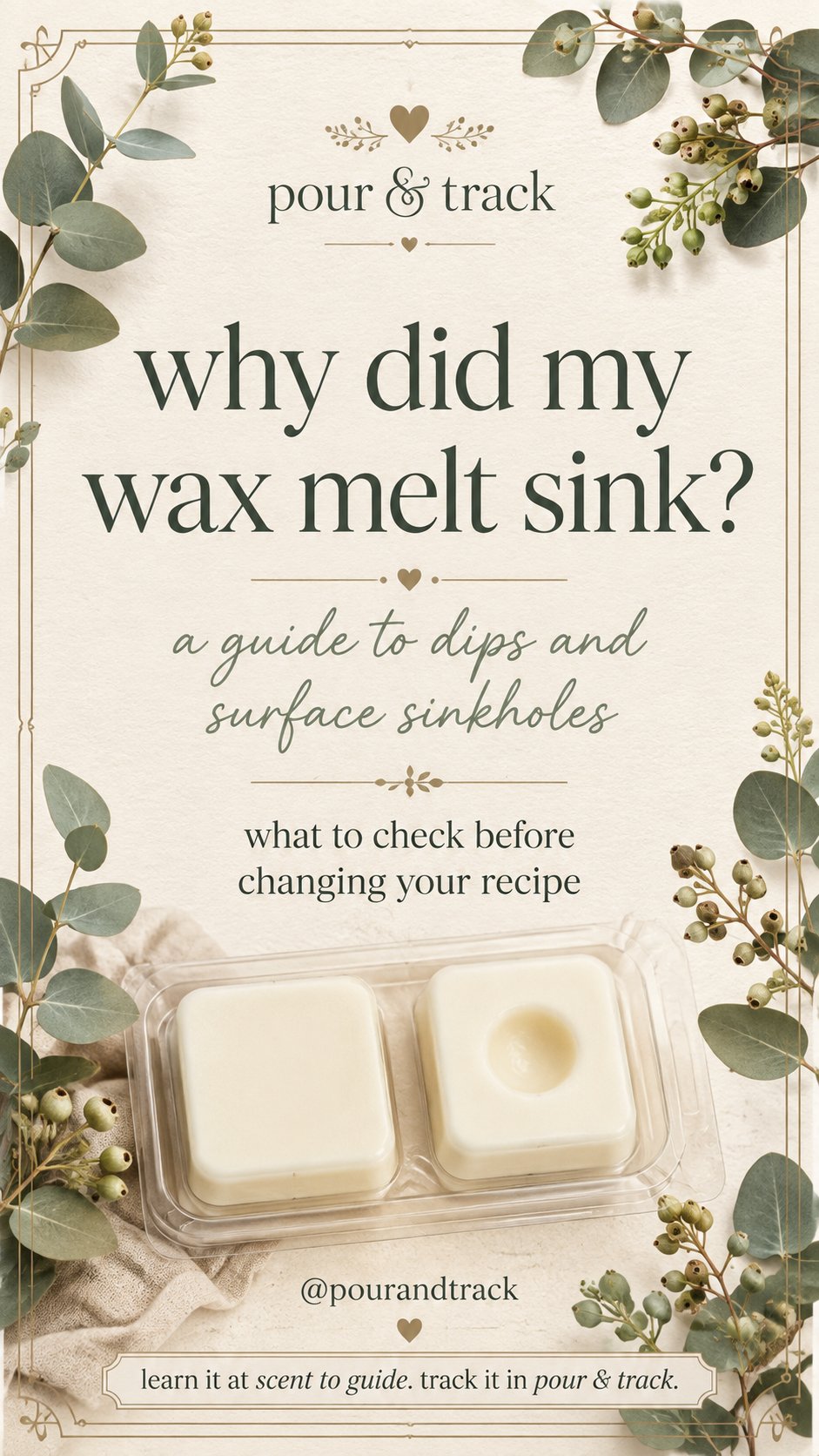
7-page guide · dips and surface sinkholes
Why did my wax melt sink?
A guide to dips and surface sinkholes — what to check before changing your recipe.
You pour a clean batch, come back an hour later, and half the cavities have a hollow in the middle. Before you reach for a different wax or drop your fragrance load, it's worth checking whether it's a recipe problem at all. Often it comes down to cooling, pour temperature or the mould itself — and sometimes it's purely cosmetic.
1. What is a sinkhole — and when is it just a dip?
- ✓ A sinkhole is a sunken area or hollow that appears as the wax cools
- ✓ Some melts show a deep centre dip, others just a shallow surface hollow
- ✓ It's a surface issue, not always a recipe failure
Small dips can be common as wax contracts while cooling.
2. Cooling can play a part
Uneven cooling matters more than most people expect.
- ✓ Wax cools from the outside in
- ✓ If the centre cools and contracts later, a dip can appear
- ✓ Draughts, cold surfaces or different room conditions can make this more noticeable
Before changing your recipe, consider how the melts cooled.
3. Pour temp and mould shape matter too
Small details can affect the finish.
- ✓ A hotter or cooler pour can change how the top sets
- ✓ Deeper shapes or narrow centres may be more likely to show a dip
- ✓ Some moulds simply highlight cooling changes more than others
Change one variable at a time so you can see what actually helped.
4. Sometimes it's just cosmetic
A small dip doesn't always mean disaster.
- ✓ If the melt still looks clean and performs well, a shallow dip may only be visual
- ✓ Not every surface change means the wax is unusable
- ✓ The key is spotting whether it happens once or keeps repeating
Look for patterns, not just one imperfect melt.
5. What to record before changing anything
This is where Pour & Track helps.
- ✓ Wax type and batch
- ✓ Fragrance percentage
- ✓ Melt temperature
- ✓ Pour temperature
- ✓ Room temperature
- ✓ Mould or clamshell used
- ✓ What the surface looked like
Record each trial batch in Pour & Track — wax, fragrance load, melt and pour temps, room temp, mould and a note on the surface. Once two or three batches are logged, the pattern usually shows itself, and the next test isn't guesswork.
Made for makers who want less guessing and better records.
DownloadFree · 7-page guide · PDF
Save this before your next melt pour and work through it step by step.